The Space Between
On living in the liminal — and finding your footing anyway

There are seasons in life when you are no longer where you started, but the place you are going hasn’t fully arrived yet.
The old map no longer works.
The new one hasn’t appeared.
You are simply… in between.
Anthropologists call this space liminal — the threshold between what was and what will be. It is the middle phase of transformation, when the old identity dissolves before the new one has fully formed.
If you have ever moved across the country, launched a child into adulthood, stepped into a new leadership role, or cared for someone whose life is changing, you know this space intimately.
It’s not quite being lost.
But the familiar suddenly looks different.
I’ve Been Here Before
The first time I felt this deeply, I was fourteen.
My parents moved our family from Boston to Houston, and overnight the structure of my world changed. The corner store. The friends I had grown up with. The streets I knew by instinct.
Everything that had quietly anchored my sense of belonging was suddenly gone.
I’ve felt that same in-between feeling at other crossroads — during college when I was searching for direction, when I moved to California for graduate school, and again when I left New York for the next chapter of my life.
One moment from New York still stays with me.
I came up out of the subway at my usual stop — a place I had surfaced from hundreds of times — and for a brief moment I didn’t recognize where I was.
It had rained and then frozen. Every branch along the street was encased in ice, like the neighborhood had been dipped in glass.
The same buildings were there.
The same path home.
But everything looked unfamiliar.
I stood there for a moment, disoriented.
Then I followed the memorized path home.
That’s what the liminal state feels like.
Everything familiar — rendered strange.
The Season I’m In Now
I find myself there again.
My son is preparing to leave for college, stepping into the beginning of his adult life.
My mother is moving across the country and entering a new chapter after decades of independence.
And somewhere between those two thresholds, I’m still holding the responsibilities of leadership — supporting my team, guiding projects forward, and trying to show up well for the people who rely on me.
This is what the liminal state looks like in adulthood.
You’re not between cities.
You’re between versions of your life.
And often you’re navigating your own uncertainty while holding steady for the transitions of the people you love.
What the Research Says About Being “Between”
Anthropologist Arnold van Gennep first described liminality as the middle phase of any major life transition — the stretch after we leave the old world but before the new one has stabilized.
What makes this phase difficult isn’t just uncertainty.
It’s that the identity markers we relied on to understand ourselves temporarily go quiet.
Arthur C. Brooks, who teaches Leadership and Happiness at Harvard Business School, describes meaning as the most essential nutrient of a good life — the deep sense of purpose beneath everything else.
During major transitions, that sense of meaning can feel like it disappears.
Not because our lives have lost it.
But because the structures that used to reflect it back to us have shifted.
Brooks offers a helpful reframe:
Happiness isn’t a destination.
It’s a direction.
You don’t arrive.
You orient.
The Chrysalis Stage of Life
Hospitality entrepreneur and leadership thinker Chip Conley offers another metaphor for this stage: the chrysalis.
Inside a chrysalis, a caterpillar doesn’t simply grow wings.
Its body actually dissolves into something close to cellular soup before reorganizing into a butterfly.
From the outside, it looks like nothing is happening.
But inside, everything is reorganizing.
Conley argues that many adults experience similar seasons — stretches when the structures that once defined us begin to shift long before the next version of ourselves becomes visible.
Feeling disoriented during transition isn’t a sign that something has gone wrong.
It may simply mean that something new is forming.
Three Ways to Stay Grounded in the In-Between
When the larger structure of life feels uncertain, small practices can help us stay oriented.
These are three that are helping me right now.
1. Name the threshold you’re standing in
Instead of rushing past uncertainty, try naming it.
Write it down.
Say it out loud.
Tell one person who can hold it with you.
Research shows that labeling emotions reduces activity in the brain’s threat center.
Simply naming what we are experiencing helps restore a sense of clarity.
You’re not wallowing.
You’re locating yourself on the map.
2. Protect one steady anchor in your day
In every liminal season there is usually one small thing that still feels steady.
A morning walk.
A conversation with someone who knows you well.
A quiet moment before the day begins.
Right now for me, it’s a walk before the day starts.
It doesn’t solve the uncertainty.
But it gives my mind a place to land before everything else begins moving.
When the larger structure of life feels unsettled, small anchors matter more than we think.
3. Close the day with three reflections
Before I fall asleep each night, I take a moment to think through three simple things.
Three things I accomplished
Examples might include:
• Showing up for work
• Supporting my mom through a difficult day
• Making dinner for my son
Then I pause and congratulate myself.
Sometimes I literally say:
Look at that. I showed up today. I crushed the day!
Three things I’m grateful for
Examples might include:
• A healthy body
• The sunlight on my morning walk
• The smile someone gave me during the day
And I take a moment to lean into that gratitude.
Three dreams I hope to see come true
Examples might include:
• Financial abundance
• A home that allows my family and friends to be relaxed and supported in
• Making a meaningful difference in someone’s life
I imagine those possibilities vividly — seeing them, feeling them, letting them exist as real possibilities.
It’s a simple ritual.
But it has a quiet way of closing the day with perspective, even when the larger questions remain unanswered.
The Trees Were Still There
The morning after that frozen night in New York, the ice began to melt.
The branches were just branches again.
The street was just a street.
Nothing had actually changed.
For a moment, I had simply lost the ability to recognize the familiar.
That’s the thing about the liminal state.
It doesn’t mean you’re lost.
It means you’re between.
And between is not the same as lost.
You left something real.
You’re heading somewhere real.
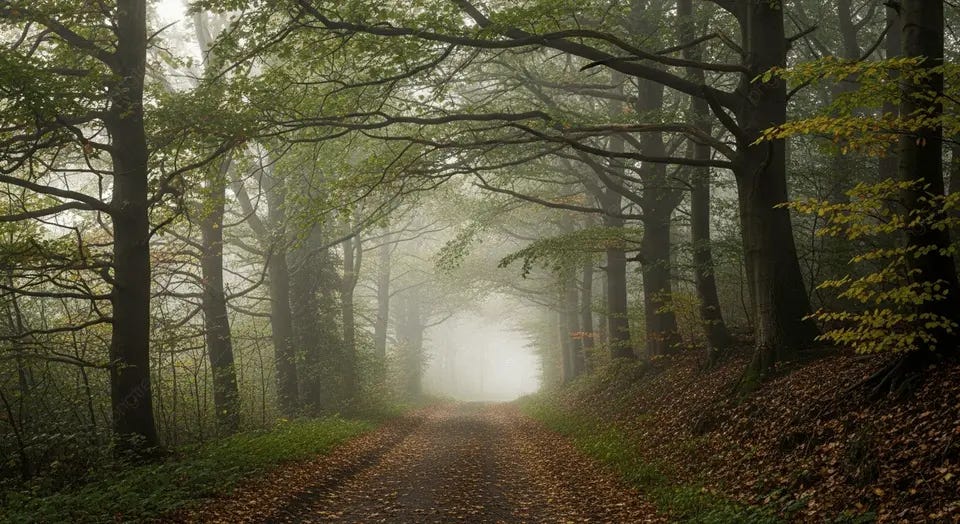
The road in the middle is still road.
Keep going.
Let’s go — 🚀
Sources & Further Reading
Van Gennep, Arnold. The Rites of Passage. University of Chicago Press, 1960.
Brooks, Arthur C. From Strength to Strength: Finding Success, Happiness, and Deep Purpose in the Second Half of Life. Portfolio/Penguin, 2022.
Brooks, Arthur C., and Oprah Winfrey. Build the Life You Want: The Art and Science of Getting Happier. Portfolio/Penguin, 2023.
Conley, Chip. Learning to Love Midlife. Penguin Life, 2024.